Folding Decades into an Afternoon
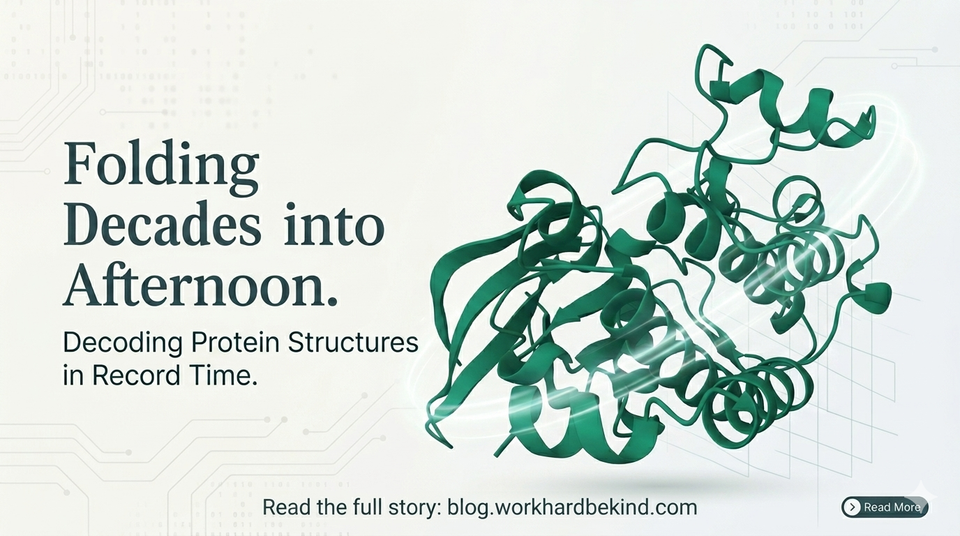
In the early 1990s, a team at Novartis (then Ciba-Geigy) started chasing a small molecule called STI-571. Their target was a tyrosine kinase named ABL1 — and specifically the BCR-ABL fusion form of it that drives chronic myeloid leukemia. CML, before this drug, was a five-year death sentence for most patients.
STI-571 wedged itself into ABL1's ATP-binding pocket and switched the kinase off. By the time it became Gleevec (imatinib) and reached FDA approval in 2001, it had spent more than a decade in the pipeline. CML mortality fell by roughly 80% in the years that followed. It is still cited as one of the cleanest targeted-therapy success stories ever produced.
I bring this up because last night, on the workstation under my desk, I folded the ABL1 kinase domain into a 3D structure in nine seconds.
That's not a press release. It's not even a particularly clever thing to do anymore. It's just where we are.
What "where we are" looks like
The compressed version: a single GPU with 32 GB of VRAM, a 3B-parameter model called ESMFold, an open-source molecular dynamics engine called OpenMM, and a Claude-backed assistant that can reason over the files those tools produce. Ten years ago each of those pieces would have been a graduate student. Five years ago each would have been a paper. Today they are pip installs.
Concretely, on a workstation tonight, a researcher can:
- Fold any protein from sequence alone in seconds-to-minutes. ESMFold from Meta, AlphaFold from DeepMind, Boltz from MIT. Single-sequence, no MSA required, no cluster.
- Run molecular dynamics on a GPU. OpenMM with the CUDA platform on an RTX 5090 will simulate small proteins at hundreds of nanoseconds per day on a single card. That is enough to watch a binding loop breathe, watch a mutation destabilize a helix, watch water jostle into and out of a pocket.
- Ask an AI copilot to reason over the result. Not "summarize this PDB" — reason. "Where is the gatekeeper residue in my structure? What residues sit within 5 Å of it? Which of those are conserved? Run an MD simulation and tell me whether the activation loop is more flexible in the T315I mutant than in wild-type."
That last category is the part that has changed the texture of the work. The model isn't doing the science. It's doing the accounting around the science — which used to take more time than the science itself.
Why this matters for medicine, specifically
The Gleevec story has a sequel that explains the stakes.
A few years after imatinib was approved, oncologists started seeing patients relapse. Sequencing the tumors revealed a single point mutation in ABL1 — T315I, the so-called "gatekeeper" mutation — that swapped a small threonine for a bulky isoleucine and physically blocked imatinib from sitting in its pocket. A new generation of inhibitors had to be designed around it. Ponatinib, the first one to clear T315I, took another decade.
Now imagine that loop with a modern toolkit:
- Fold wild-type ABL1 → obvious binding pocket.
- Fold T315I → the gatekeeper sidechain is now bulky, the pocket geometry shifts.
- Simulate both in MD at 310 K → the activation loop dynamics change measurably within a few nanoseconds.
- Ask the copilot to suggest analogs whose chemistry tolerates an isoleucine at that position.
None of this replaces the chemistry, the wet lab, the clinical trials. The molecule still has to be synthesized. It still has to be safe. It still has to actually work in a human body, which is a thing computers have a famously incomplete model of.
But the inner loop — the part where you generate, screen, and discard hypotheses — is collapsing from years to days. For diseases where the target is well-defined (kinase inhibitors, GPCR antagonists, antibody design), that loop is the bottleneck.
The quieter revolution: rare disease
The drug industry's economics have always punished rare diseases. If a condition affects 200 people worldwide, no commercial team can justify a 10-year, billion-dollar development cycle for it. So those patients have historically had nothing.
What changes when an academic lab — or a clinician with a 5090 — can:
- Take a patient's mutant protein sequence
- Fold it
- Compare it structurally to the wild-type
- Identify the mechanism of dysfunction
- And screen a library of approved drugs for repurposing candidates
in an afternoon? It doesn't fix the economics. But it makes the work possible at all, which it sometimes wasn't before. The barrier shifts from "no one can afford to look" to "look, then decide whether the answer is worth pursuing." That is a different world.
What AI doesn't fix
It is worth being honest. None of this is automated drug discovery. The models are confident-sounding even when they are wrong. They will hallucinate ligand contacts that don't exist. They will fold disordered regions into structured ones. They will quietly fail on membrane proteins. They are tools, and like all tools they reward the people who already know what they're looking at.
The clinical end of the pipeline — toxicity, off-target effects, immune response, individual genetic variation, the entire mess of actual human bodies — still happens at the speed of biology. Trials take years because biology takes years.
What's changed is the front end: the part where you decide what to test. That used to be the gating step, and now it isn't.
A note on infrastructure
The reason I find this moment interesting is not that it's powerful. The reason is that it's portable. Ten years ago this kind of work required a cluster, a university account, and someone's grant. Five years ago it required a cloud bill. Today it runs on a workstation in a spare room.
The model weights are open. The simulation engines are open. The assistant — Anthropic's Claude in my case — is API-billed at fractions of a cent per query. The whole stack fits in a Dockerfile. A motivated undergraduate, a clinician with a curiosity, a patient with a rare diagnosis and a willingness to learn — any of them can now do work that used to require a building.
That is, I think, the actual revolution. Not that AI can fold proteins. That anyone can.
Demo here
ESMFold weights from Meta. OpenMM from Stanford / conda-forge. Reasoning by Claude. Imatinib still by Novartis.
Preteinlab made with love from Virginia.