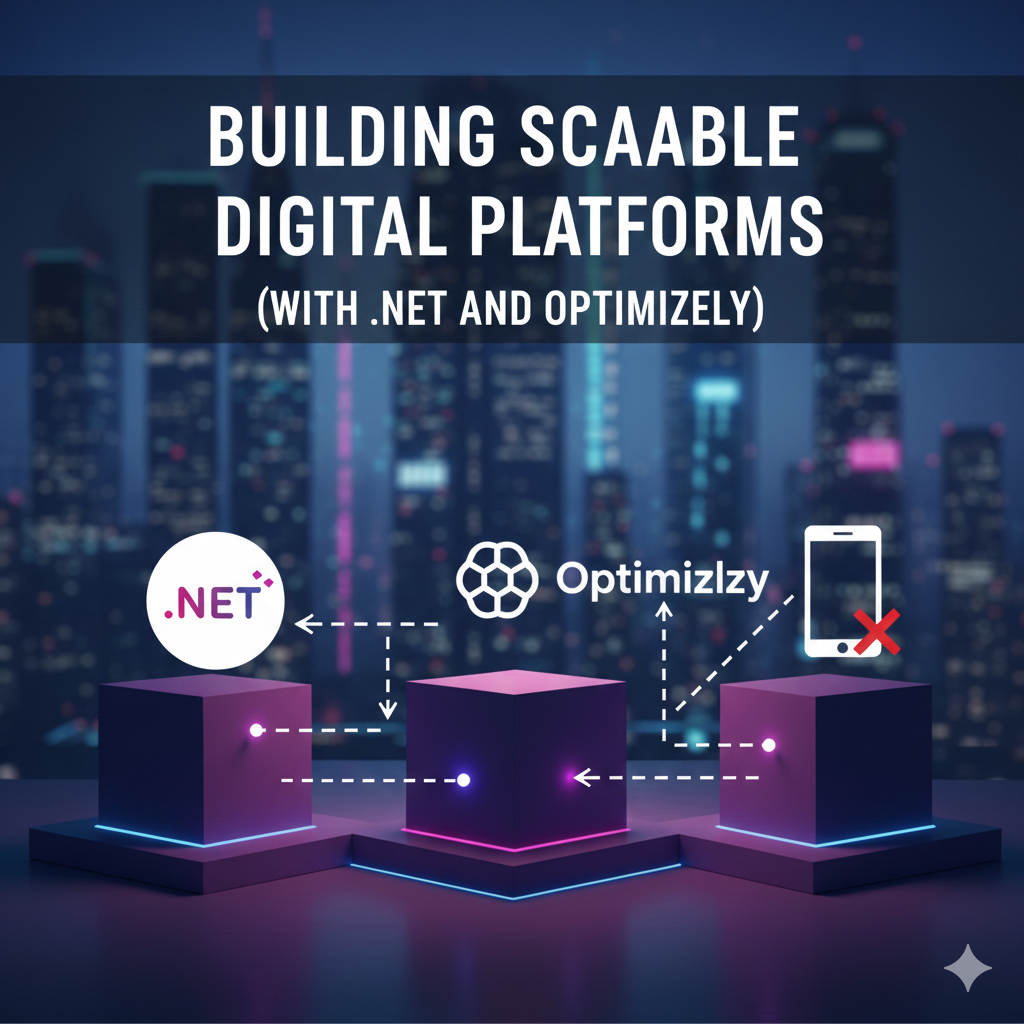
Building Scalable Digital Platforms with .NET and Optimizely
.NET as a Foundation for Digital Platforms
Modern .NET (ASP.NET Core) is designed for high throughput, low latency, and cloud-native workloads. Its modular architecture and first-class tooling make it well suited for large-scale digital experience platforms.
Key technical advantages include:
- High-performance runtime backed by Kestrel and optimized async I/O
- Dependency Injection (DI) built into the framework
- Cross-platform execution across Windows, Linux, and containers
- Strong typing and compile-time safety for maintainable codebases
- Native cloud support, especially on Azure
These characteristics make .NET a strong backbone for CMS, commerce, and API-driven architectures.
Optimizely Architecture Overview
Optimizely CMS and Commerce are built on ASP.NET Core, aligning closely with standard .NET development patterns. Under the hood, Optimizely provides:
- MVC-based rendering pipelines
- Strongly typed content models using C#
- An extensible event and initialization system
- Built-in caching and content delivery optimizations
- API-first access via REST and GraphQL
This allows teams to extend the platform without sacrificing maintainability or performance.
Strongly Typed Content Models
One of Optimizely’s biggest advantages for developers is its use of strongly typed content models:
[ContentType(DisplayName = "Article Page")]
This approach provides:
- Compile-time validation
- Refactoring safety
- IDE autocompletion
- Clear contracts between content and rendering logic
Compared to schema-less or JSON-driven CMS platforms, this significantly reduces runtime errors and improves long-term maintainability.
Customization via Dependency Injection and Middleware
Optimizely integrates seamlessly with ASP.NET Core’s DI container, allowing developers to override or extend default services:
services.AddTransient
Additionally, Optimizely supports:
- Custom middleware in the request pipeline
- Initialization modules for startup configuration
- Event handlers for content lifecycle events (publish, save, delete)
This makes it easy to inject cross-cutting concerns such as caching, logging, and authorization.
Experimentation and Feature Flags in Code
Optimizely’s experimentation capabilities go beyond the marketing layer. Feature flags and experiments can be controlled directly in .NET code:
if (_featureManager.IsEnabled("NewCheckoutFlow")){return NewCheckout();}return LegacyCheckout();
This enables:
- Progressive delivery
- Canary releases
- Safer refactoring of critical paths
- Data-driven validation of architectural changes
For engineering teams practicing DevOps or trunk-based development, this is a significant advantage.
Headless and Hybrid Architectures
Optimizely supports headless CMS scenarios while still enabling server-side rendering when needed. Common patterns include:
- ASP.NET Core backend + React/Next.js frontend
- GraphQL for content delivery
- Hybrid rendering for SEO-critical pages
This flexibility allows teams to evolve architectures incrementally rather than committing to a full rewrite.
Performance and Caching Considerations
Optimizely provides multiple layers of caching:
- Output and partial caching
- Object and content caching
- CDN integration
Combined with ASP.NET Core performance features and cloud-native scaling, this enables high-traffic applications with predictable performance.
DevOps and Cloud Deployment
Optimizely applications fit naturally into modern CI/CD pipelines:
- Infrastructure hosted on Azure App Service or Kubernetes
- Automated builds with GitHub Actions or Azure DevOps
- Slot-based deployments for zero-downtime releases
- Observability through Application Insights
The result is a platform that supports continuous delivery without sacrificing stability.
Final Thoughts
For technical teams, the strength of .NET + Optimizely lies in its alignment with established engineering practices. You get:
- A familiar, testable, and extensible .NET codebase
- Strong typing and compile-time guarantees
- Built-in experimentation and feature management
- Cloud-ready scalability and performance
If your team is building a digital platform that must support rapid iteration, experimentation, and long-term maintainability, Optimizely on .NET is a stack worth serious consideration.