The AI Force Multiplier: Why "Time and Money" Are No Longer Your Biggest Constraints
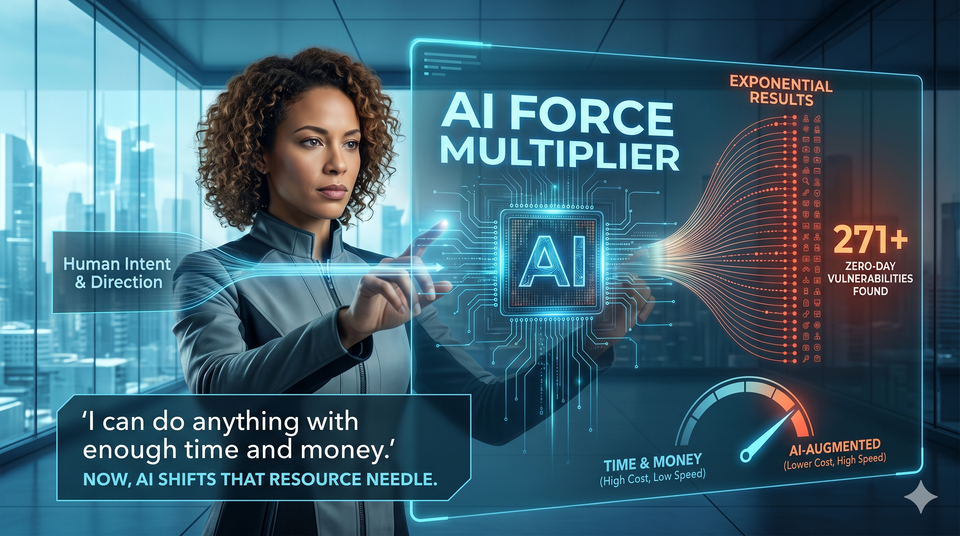
Years ago, I worked under a director who had a favorite mantra for whenever we faced an "impossible" technical challenge: “I can do anything with enough time and money.”
It was the ultimate pragmatist’s truth—a reminder that engineering isn’t magic—it’s a resource allocation problem. If you wanted a perfectly secure system, you just needed enough elite researchers and enough years to comb through every line of code. The problem, of course, was that nobody ever had enough of either.
But we have entered an era where the fundamental physics of that equation have changed. Artificial Intelligence is acting as a massive force multiplier, and in doing so, it is shifting the resource needle in ways that make the "impossible" suddenly affordable.
The Old Needle vs. The New Reality
In the traditional software lifecycle, the "resource needle" was pinned by human limitations. Humans are brilliant, but they don't scale. If you wanted to find deep, architectural flaws in a codebase as complex as a modern web browser, you needed a "Manhattan Project" level of talent and funding.
AI has broken that bottleneck. It doesn’t just work faster; it changes the economic viability of exhaustive analysis. We are no longer asking, "Can we afford to check this?" but rather, "How many times should we check this today?"
Case Study: 271 Zero-Days in Firefox
The most staggering proof of this shift just hit the headlines. As reported by Ars Technica, Mozilla and Anthropic’s "Mythos" AI model recently identified 271 zero-day vulnerabilities in Firefox 150.
Let that number sink in.
In the "Time and Money" era, finding a single zero-day vulnerability in a battle-hardened browser like Firefox was a six-figure achievement that could take a researcher months. Finding 271 of them would have required a small army of the world’s best security researchers and a budget in the tens of millions of dollars. It was, for all intents and purposes, a task that required "infinite" resources.
By using Mythos as a force multiplier, Mozilla didn't just speed up their security audit; they effectively collapsed the cost of elite-level security research. They moved the needle from "prohibitively expensive" to "operationally standard."
What Happens When the "Impossible" Becomes "Standard"?
When my former director said he could do anything with enough time and money, he was talking about the ceiling of what was possible. AI is effectively lowering that ceiling until it’s within arm’s reach of every developer.
- Defense Scales Faster Than Offense: For years, the advantage went to the attacker—they only had to find one hole, while defenders had to plug them all. With AI force multipliers, defenders can now audit entire ecosystems in the time it used to take to audit a single module.
- The End of "Good Enough" Security: We used to ship code with known risks because we lacked the resources to find every edge case. When an AI can find 271 vulnerabilities in a single sweep, the "we didn't have the time" excuse evaporates.
- Redefining Human Talent: We still need the "Time and Money" directors, but their roles are shifting. The job is no longer about managing human hours; it’s also about managing the direction of AI intelligence.
The New Bottom Line
The resource needle has shifted. The "impossible" tasks of five years ago—exhaustive code audits, real-time language translation, personalized education at scale—are now becoming matters of compute, not miracles.
My old director was right: you can do anything with enough time and money. But thanks to AI, you now need significantly less of both to change the world. We are shifting from "Do we have the resources?" to "Now that we have the power, what are we going to build?"